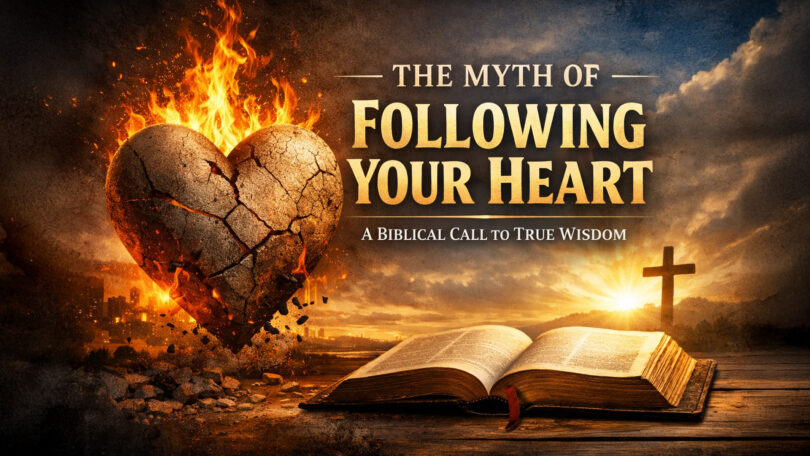

The Myth of Following Your Heart: A Biblical Call to True Wisdom
Follow Your Heart: We live in a world that relentlessly romanticizes the heart. After all, don’t we love getting heart-shaped cards on Valentine’s Day, or yearn for that burning in our chest that tells us that love must be real? Can our hearts be the true barometer to let us know we are on the right path? Can success in all aspects of life be as simple as following our hearts?
From childhood fairy tales to blockbuster movies, bestselling novels, and inspirational social media quotes, the message is constant and persuasive: “Follow your heart.” “Trust your heart.”
“Your heart knows what you truly need.”
It sounds noble. It feels empowering. It resonates deeply with our desire for authenticity and freedom. But it also stands in direct opposition to one of the most sobering truths found in Scripture.
“The heart is deceitful above all things, and desperately wicked; who can know it?” — Jeremiah 17:9 (NKJV)
This is not a popular verse. It doesn’t fit neatly into a movie script or a motivational poster. Yet it is one of the most honest diagnoses of the human condition ever written.
A Culture Built on Emotional Authority
Modern culture treats the heart as the ultimate authority. Feelings are elevated above reason. Desire is placed above discipline. Emotion is crowned king.
Movies tell us that love conquers all, even wisdom, boundaries, and covenant. Books urge us to abandon caution in pursuit of passion. Songs celebrate reckless devotion. Even children’s stories repeat the theme: “Believe in yourself. Look within. The answer is already in your heart.”
There is a biological hook. ( from Kahneman, D. (2011). Thinking, Fast and Slow. Farrar, Straus and Giroux.)
Following your heart is often a euphemism for following your limbic system (the emotional brain) rather than your prefrontal cortex (the executive, rational brain). We can often feel the struggle in real-time, but often give in to the emotion. We are seduced by hope that defies reason and that lacks historical support.
Rational decision making consumes massive amounts of energy and feels like work. Emotional decisions happen instantly and feel automatic. When we decide to follow our hearts, we give ourselves permission to stop the exhausting work of analyzing the pros and cons leading to an intelligent decision.
In addition, the “heart” usually wants things that offer immediate gratification (love, food, excitement). The anticipation of this gratification releases dopamine. Sadly, logic, which often involves delaying gratification for long-term gain, does not offer this chemical kick.
We trust the idea even though there is little historical evidence to support the idea.
Therefore, the phrase, “follow your heart” is still one of the most seductive and repeated pieces of advice in human history because it appeals to our biological wiring.
But what Scripture tells us directly, may surprise you on this topic. Did you know that the Bible never tells us to follow our hearts. Not once. Instead, it repeatedly warns us about our hearts.
“He who trusts in his own heart is a fool, but whoever walks wisely will be delivered.” — Proverbs 28:26
This verse alone dismantles the modern worldview. Trusting your heart is not presented as courageous or enlightened—but as foolish.
A Personal Story: When My Heart Was Confident—and Wrong
I speak about this not as a detached observer, but as a man shaped by painful experience. I have been married three times. Each time I stood at the altar, I was sincere. Each time I believed—truly believed—that I was making the right choice. Each time, my heart told me this was the person God had for me. My heart was confident. My emotions were strong. My feelings were convincing.
And twice, my heart was wrong. I am still married to my third wife, and I thank God for the grace and redemption He continues to work in my life. But I cannot ignore the pattern. My heart—untethered from wisdom, discernment, and submission to God—led me into repeated pain. I didn’t enter those marriages trying to disobey God. I wasn’t trying to rebel. I was following what felt right. I was following my heart.
And Scripture had warned me all along.
“There is a way that seems right to a man, but its end is the way of death.” — Proverbs 14:12 Notice the wording: seems right. It feels right. It appears right. It resonates emotionally. Yet it leads to destruction.
Why the Heart Is a Poor Compass
The heart is not evil because it feels—it is dangerous because it deceives. The heart wants what feels good now, not what is right long-term. It seeks relief, affirmation, pleasure, and connection—often without regard for consequences.
Jesus Himself explained this clearly: “For out of the heart proceed evil thoughts, murders, adulteries, fornications, thefts, false witness, blasphemies.” — Matthew 15:19
The heart is not neutral. It is not a blank slate waiting for inspiration. It is shaped by sin, fear, unmet needs, wounds, pride, and desire. Left unchecked, the human heart is like a compass spinning wildly—pointing toward whatever feels most satisfying in the moment.
Our Hunger for Wisdom
Every human being longs for wisdom. We want to make good decisions. We want to avoid regret. We want peace. The problem is not the desire for wisdom—it’s where we look for it.
The world tells us wisdom comes from within. The Bible tells us wisdom comes from above. Consider this passage from James 1:5, “If any of you lacks wisdom, let him ask of God, who gives to all liberally and without reproach.”
We live in the Information Age. If you lack facts, you ask Google. If you lack data, you ask AI. But having access to all the information in the world has not made us wiser. In fact, it often leads to analysis paralysis—the state of over-thinking a decision to the point that a choice never gets made.
Today, wisdom isn’t about knowing the facts; it is about having the discernment to know what to do with the facts. It is the ability to cut through the noise of social media, news, and infinite opinions to make the right choice for your life, family, or business.
Wisdom is not discovered by introspection alone. It is received through humility and dependence on God. “The fear of the Lord is the beginning of wisdom.” — Proverbs 9:10
This is foundational. Wisdom does not begin with confidence in self, but with reverence for God. Without that fear, what we call “wisdom” is often just rationalized desire.
The Volvo Paradox
I often confess to my Sabbath School class that there is one specific prayer God keeps sending straight to voicemail. It involves a Volvo.
I currently drive an old one, and it serves me well. But have you seen the new ones? They are Scandinavian perfection on wheels. Naturally, being a man of faith, I took this desire to the Lord. I didn’t just ask; I presented a business case.
I used my best “sanctified logic.” I prayed, “Lord, think of the safety for my family. Think of the reliability! Imagine how much better I could serve the church mission in a vehicle that doesn’t make strange rattling noises.” Oh, the things I could do for Your Kingdom in an XC90! It was a compelling argument. But God, in His love and infinite wisdom, has has not said yes.
And here lies the friction between following your heart and seeking true wisdom. My heart says, “If you had the money, you should buy it. It’s for a good cause!” But Wisdom asks the harder question: “Just because you can, does that mean you should?” “What is the true motivation to have this impressive, impressive car”
True wisdom is recognizing that sometimes God doesn’t answer our prayers because He is trying to protect our stewardship. My heart wants the heated seats; Wisdom wants me to be faithful with the resources I actually have, not the ones I wish I had. In this there is plenty to learn about following Him and not serving myself.
What Is Truth?
Pilate famously asked Jesus, “What is truth?” (John 18:38). It is a question humanity continues to wrestle with. The world defines truth as personal and flexible. “Your truth” and “my truth” coexist, even when they contradict.
But Jesus spoke with clarity: “I am the way, the truth, and the life.” — John 14:6
Truth is not found in feelings manufactured my the heart. It is found in a Person.
The Word of God is truth: “Sanctify them by Your truth. Your word is truth.” — John 17:17
When truth is detached from Scripture, feelings rush in to fill the void. And feelings make terrible gods. Feeling often lead to actions that often lead to unexpected (or expected) consequences.
The Illusion of Peace
Many people follow their hearts in search of peace. They believe that if something feels peaceful, it must be right. But Scripture warns us of false peace. “There is no peace,” says the Lord, “for the wicked.” — Isaiah 48:22
True peace does not come from satisfying desire. It comes from obedience. “Great peace have those who love Your law, and nothing causes them to stumble.” — Psalm 119:165
Left to ourselves, the answer is no. We are not neutral decision-makers. We are fallen creatures with broken instincts. “All we like sheep have gone astray; we have turned, every one, to his own way.” — Isaiah 53:6 Sheep don’t rebel intentionally—they wander. They drift. They follow impulses. We are no different. Left to our own hearts, we are like moths to a flame—drawn to what glows, unaware of the burn that follows.
Aligning The Heart
The cultural mantra “follow your heart” is dangerous because feelings are transient. One day your heart wants the Volvo; the next day it might want a sports car, and the next it might want to quit everything and move to a cabin. Aligning your heart with God provides stability. It prevents you from being tossed around by every passing desire or marketing campaign. It changes the pursuit from “what do I want right now?” to “who am I called to be?”
“Trust in the Lord with all your heart, and lean not on your own understanding.” — Proverbs 3:5. Notice the irony: we are told to use our hearts—but not to trust them. Instead, our hearts are to be placed under God’s authority.
When the Heart (passion) and the Mind (plan) are not aligned with God (purpose), you experience stress and cognitive dissonance. You might get the car, but you lose your peace because deep down, you know it wasn’t the right move. A good question to ask is, “If God is not in it, then why am I in it?”
When all three align, you get integrity. Integrity literally means “wholeness.” It means your desires, your logic, and your spirit are all pulling in the same direction. That is the only place where true stewardship happens—where you aren’t just spending money, but managing resources for a higher calling. “In all your ways acknowledge Him, and He shall direct your paths.” — Proverbs 3:6
Direction comes not from emotion, but from surrender.
God does not leave us alone in decision-making. “When He, the Spirit of truth, has come, He will guide you into all truth.” — John 16:13 The Spirit does not affirm every feeling—weighs them. He does not echo desire—He corrects it.
“For as many as are led by the Spirit of God, these are sons of God.” — Romans 8:14
Being led by the Spirit often means resisting the heart.
Your heart lives entirely in the “now.” It sees the shiny Volvo, feels the desire, and screams, “I need this to be happy!” It prioritizes immediate gratification. The Holy Spirit operates with an eternal perspective. He sees the ripple effects of your choices ten years down the road. To be led by the Spirit, you have to resist the heart’s demand for “now” in exchange for God’s “later” (or God’s “better”).
As mentioned above, Jeremiah 17:9 says, “The heart is deceitful above all things…” Our emotions are experts at lying to us. Your heart can convince you that a “want” is a “need” (e.g., “I need this car for safety”). The Spirit is the “Spirit of Truth.” It cuts through emotional rationalizations. You have to actively ignore the emotional sales pitch your heart is giving you and look at the cold, hard truth of scripture and stewardship.
At its core, the human heart is wired for self-preservation and self-promotion. It asks, “What will make me look good? What will make me comfortable?” The Spirit is wired to glorify God. It asks, “What will make God look good? How can I serve others?” Following the Spirit often feels like a death to self. You are denying your ego (the Volvo) to feed your spirit (Stewardship).
James 3:14–16 “But if you have bitter envy and self-seeking in your hearts, do not boast and lie against the truth. This wisdom does not descend from above, but is earthly, sensual, demonic. For where envy and self-seeking exist, confusion and every evil thing are there.”
A Redeemed Heart
God’s solution is not to discard the heart—but to transform it. We might be tempted to think the solution to a deceitful heart is to become a spiritual Stoic—suppressing all desire and emotion to ensure we never make a mistake. But God created us to feel, to dream, and to desire. His plan is not to silence the heart, but to transplant it.
In Ezekiel 36:26, God promises, “I will give you a new heart and put a new spirit within you.” This is the crucial difference between behavior modification and spiritual transformation. The Holy Spirit doesn’t just veto our requests; He actually changes our “I Want.” As we align with Him, the promise of Psalm 37:4 comes into focus: “Delight yourself also in the Lord, and He shall give you the desires of your heart.” This isn’t a guarantee that God will give you the Volvo if you pray enough; it is a promise that as you delight in Him, your desires will begin to mirror His. The ultimate goal isn’t a suppressed heart, but a synchronized one.
“The steps of a good man are ordered by the Lord.” — Psalm 37:23 And in Him—not in our hearts—we find wisdom, truth, and peace.
I make this final point. The Bible shares that David was a man after God’s own heart. This is a powerful statement to make, and should inform how we live our lives today. Are we men and women that are after God’s own heart?